
































Boston Dynamics robot dog explained for wider use
Boston Dynamics’ four-legged robot, widely known as the robot dog, has moved from laboratory demonstrations into everyday industrial and public-sector settings, reflecting a shift in how mobile robotics is being adopted across inspection, safety and data-collection roles. The machine, marketed as Spot, is designed to traverse environments that are difficult or hazardous for humans, combining advanced mobility with sensors and autonomous navigation software. Developed by Boston […] The article Boston Dynamics robot dog explained for wider use appeared first on Arabian Post.
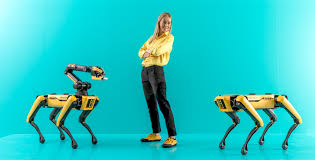

Boston Dynamics’ four-legged robot, widely known as the robot dog, has moved from laboratory demonstrations into everyday industrial and public-sector settings, reflecting a shift in how mobile robotics is being adopted across inspection, safety and data-collection roles. The machine, marketed as Spot, is designed to traverse environments that are difficult or hazardous for humans, combining advanced mobility with sensors and autonomous navigation software.
Developed by Boston Dynamics, the robot dog is a compact, battery-powered quadruped capable of walking, climbing stairs and maintaining balance on uneven ground. It carries cameras providing 360-degree vision, depth perception and thermal imaging, allowing it to map spaces and identify anomalies such as heat leaks, corrosion or structural damage. The system can be remotely operated or follow pre-programmed routes, reducing the need for constant human supervision.
Adoption has broadened beyond research institutions into sectors such as energy, construction, manufacturing and emergency response. Utilities deploy the robot to inspect substations and offshore platforms where exposure to high voltages, confined spaces or harsh weather creates safety risks. Construction firms use it to capture site data, compare progress against digital models and flag deviations early, while factories employ it for routine patrols that monitor equipment health during off-hours.
The technology’s appeal lies in mobility combined with data integration. Unlike wheeled robots, the quadruped design allows it to step over obstacles, open doors with an attached arm, and operate in spaces not designed for automation. Data collected can be fed into asset-management systems or digital twins, supporting predictive maintenance and operational planning. Analysts tracking industrial automation say such use cases highlight a broader trend toward robots as mobile sensing platforms rather than standalone machines.
Public-sector interest has also been notable. Emergency services have trialled robot dogs for reconnaissance after fires, explosions or chemical incidents, enabling teams to assess conditions before entering dangerous zones. During disaster response exercises, the robot has been used to search collapsed structures with cameras and microphones, relaying information to command centres in real time. Defence agencies in several countries have tested variants for perimeter monitoring and logistics support, although these deployments have sparked debate over the militarisation of robotics.
That debate has shaped how Boston Dynamics positions its technology. The company has publicly stated that it opposes weaponising its robots and has introduced licensing terms restricting such uses. This stance followed widespread discussion after videos circulated online showing robot dogs fitted with mock weapons during unrelated experiments, raising ethical and regulatory questions. The firm’s leadership has argued that clear boundaries are essential to maintain public trust and encourage responsible innovation.
Technically, the robot dog represents a convergence of advances in artificial intelligence, mechanical engineering and battery technology. Its control system uses real-time perception and machine-learning models to adjust gait and balance, while modular hardware allows customers to add sensors such as gas detectors or laser scanners. Battery life typically supports around 90 minutes of operation, with swappable packs enabling continuous use in the field.
Competition in the quadruped robot market is intensifying. Several start-ups and established manufacturers in Asia, Europe and North America have introduced similar platforms at lower price points, targeting security patrols, logistics and consumer experimentation. This has put pressure on Boston Dynamics to emphasise reliability, software maturity and support services rather than novelty alone. Industry observers note that early adopters value proven performance in harsh environments over experimental features.
Cost remains a consideration. A fully equipped robot dog, including sensors and software subscriptions, represents a significant investment, limiting uptake among smaller organisations. To address this, service-based models are emerging, allowing clients to lease robots or pay per inspection rather than purchase outright. Such arrangements mirror broader shifts in industrial technology toward subscription and as-a-service offerings.
The article Boston Dynamics robot dog explained for wider use appeared first on Arabian Post.
What's Your Reaction?