






















East Asian currencies tumble amid US-Israel-Iran war; Philippine peso over 60 vs US dollar
[Editor's Note: Follow Khaleej Times live blog amid US-Israel-Iran war for the latest regional developments.]The Philippine currency is at its lowest in history at more than P60 to a US dollar, making its scramble for more supply of fuel from abroad even more difficult and expensive amid the US-Israel-Iran war.While the Thailand Baht had the biggest dive in currency value in East Asia since the war started in West Asia last February 28, it is not the Kingdom’s lowest ever, unlike the Philippines. The Thai Baht depreciated by 5.10 per cent and is now trading at 32.49 per US dollar, while the Philippine Peso is at 60.55 to a US dollar, weakening by 4.87 per cent in the last four weeks.Stay up to date with the latest news. Follow KT on WhatsApp channels.It is not just the Philippines and Thailand that have failed to defend their currencies from the ravages of the war in the region where both countries source much of their crude oil and gas. Even the mighty South Korean economy is feeling the pinch with the Korean Won suffering a 4.54 per cent hit compared to the US dollar. It is now worth 1,508.56 KRW per 1 USD, a 17-year low.Among the sampled countries, the Taiwan dollar and Japanese yen are undergoing mild depreciations at 2.07 per cent and 1.71 per cent, respectively. The Taiwan dollar is worth 32.04 to 1 US dollar while the Japanese Yen is at 160.29 to the dollar.The Indonesian rupiah and the Vietnamese dong are weathering the storm at an identical 1.12 per cent depreciation against the US dollar since the US and Israel started hostilities. The Indonesia rupiah is at 16,990.8 while the dong trades at 26,337 to one dollar.Expectedly, the Chinese Yuan feels the crunch the least with a “slight” depreciation of 0.78 per cent due to its massive economy and foreign currency surplus. The Yuan currently trades at 6.91 to 1 US dollar.The downward trend in the region’s currencies is generally blamed to the Middle East War and the rising global oil prices that primarily trade on the US dollar. Countries that have a wide trade deficit, high inflation, and increased capital outflows suffer the economic shock more intensely such as the Philippines and Thailand.With reports of Yemeni Houthi militants joining the fray and promising to disrupt shipping lanes in the Red Sea, East Asian countries are expecting things to get even worse before they become better.Time to remit? Philippine peso slides 16.25 against UAE dirham amid US-Israel-Iran war Petrol prices up by 177%, Philippines hardest hit by Middle East crisis in Southeast AsiaPhilippines urges ASEAN neighbours to have unified economic stand to Middle East conflict

[Editor's Note: Follow Khaleej Times live blog amid US-Israel-Iran war for the latest regional developments.]
The Philippine currency is at its lowest in history at more than P60 to a US dollar, making its scramble for more supply of fuel from abroad even more difficult and expensive amid the US-Israel-Iran war.
While the Thailand Baht had the biggest dive in currency value in East Asia since the war started in West Asia last February 28, it is not the Kingdom’s lowest ever, unlike the Philippines.
The Thai Baht depreciated by 5.10 per cent and is now trading at 32.49 per US dollar, while the Philippine Peso is at 60.55 to a US dollar, weakening by 4.87 per cent in the last four weeks.
Stay up to date with the latest news. Follow KT on WhatsApp channels.
It is not just the Philippines and Thailand that have failed to defend their currencies from the ravages of the war in the region where both countries source much of their crude oil and gas. Even the mighty South Korean economy is feeling the pinch with the Korean Won suffering a 4.54 per cent hit compared to the US dollar. It is now worth 1,508.56 KRW per 1 USD, a 17-year low.
Among the sampled countries, the Taiwan dollar and Japanese yen are undergoing mild depreciations at 2.07 per cent and 1.71 per cent, respectively. The Taiwan dollar is worth 32.04 to 1 US dollar while the Japanese Yen is at 160.29 to the dollar.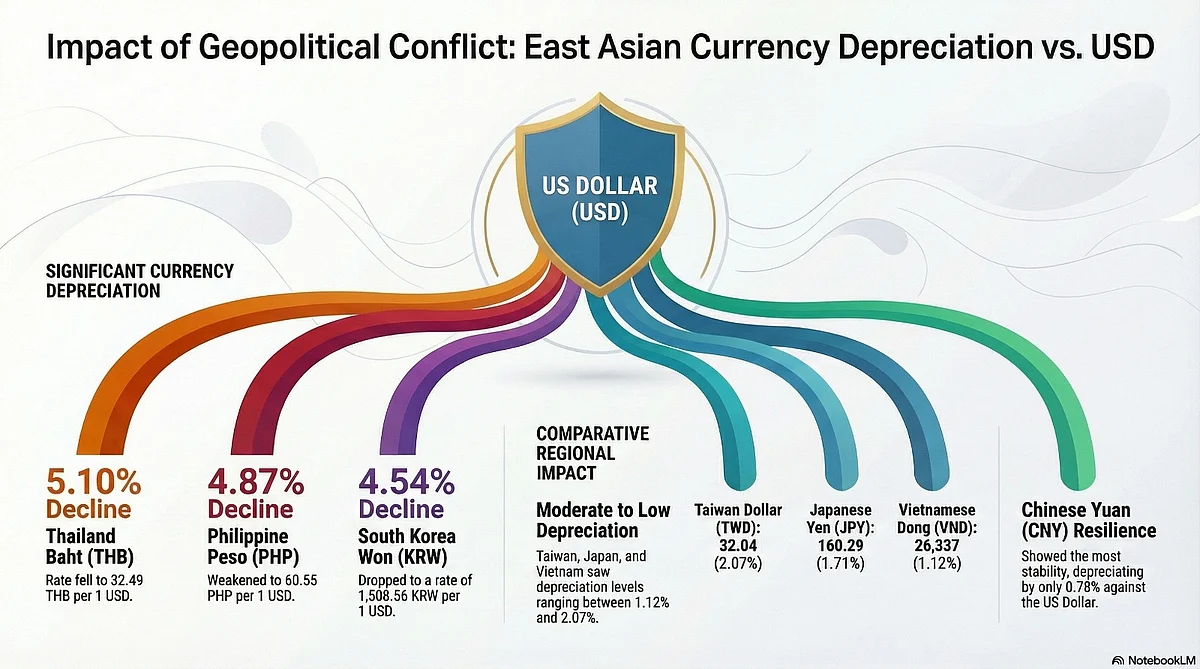
The Indonesian rupiah and the Vietnamese dong are weathering the storm at an identical 1.12 per cent depreciation against the US dollar since the US and Israel started hostilities. The Indonesia rupiah is at 16,990.8 while the dong trades at 26,337 to one dollar.
Expectedly, the Chinese Yuan feels the crunch the least with a “slight” depreciation of 0.78 per cent due to its massive economy and foreign currency surplus. The Yuan currently trades at 6.91 to 1 US dollar.
The downward trend in the region’s currencies is generally blamed to the Middle East War and the rising global oil prices that primarily trade on the US dollar.
Countries that have a wide trade deficit, high inflation, and increased capital outflows suffer the economic shock more intensely such as the Philippines and Thailand.
With reports of Yemeni Houthi militants joining the fray and promising to disrupt shipping lanes in the Red Sea, East Asian countries are expecting things to get even worse before they become better.
What's Your Reaction?