

















Modi Mustn’t Rush To Appease Trump On Trade Deal, Explore Options
By Nitya Chakraborty U.S. commerce secretary Howard Lutnick’s stunning podcast on Thursday claiming that the bilateral India-US trade deal was almost ready but was not signed as Prime Minister did not call the U.S. President Donald Trump as was expected by the Americans. This lack of proper gesture on the part of the Indian PM […] The article Modi Mustn’t Rush To Appease Trump On Trade Deal, Explore Options appeared first on Latest India news, analysis and reports on Newspack by India Press Agency). The article Modi Mustn’t Rush To Appease Trump On Trade Deal, Explore Options appeared first on Arabian Post.
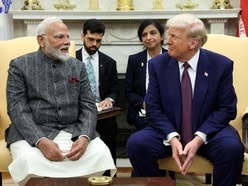
U.S. commerce secretary Howard Lutnick’s stunning podcast on Thursday claiming that the bilateral India-US trade deal was almost ready but was not signed as Prime Minister did not call the U.S. President Donald Trump as was expected by the Americans. This lack of proper gesture on the part of the Indian PM sealed the fate of the early conclusion of the deal. India has missed the train, Lutnick said. Indian foreign ministry however refuted the U.S. claim but the reaction was of I general nature saying India look forward to concluding the deal.
Lutnick is the all powerful trade secretary of the Trump administration. Through him, the U.S. President pushes all the trade deals through carrot and stick policy. He himself told the New York Times in his latest interview he is the law, he takes decisions on the basis of his own moral compass, he has not to bother about international laws. So Lutnick might have said what Trump felt. Trump wanted Narendra Modi surrendering to him with folded hands for concluding the deal. Modi, for his own political reasons, rightly did not do so as desired by his one time good friend Trump. So Modi has to pay and in the process India as a nation.
Lutnick has said India has missed the train, but the fact is that nobody misses the train whatever the U.S. President has in mind. Trump likes power and at the same time, he is vulnerable to the showing of power by the other side. Just see how the powerful U.S. President has changed his stance towards the Columbian President Gustavo Petro in 48 hours after Petro, the leftwing President of a tiny Latin American nation challenged Trump and told him to take on him. Earlier Trump said that Petro is a sick man and he will not rule long. But after this challenge of Petro, Trump changed his tune and asked Petro to talk to him in the White House and sort out the issues.
Similarly, Trump gave threat to Brazil and Mexican Presidents after they strongly came out against his invasion of Venezuela. The tone was highly aggressive immediately after January 3 kidnapping of Maduro, but the tone changed within four five days as Brazil and Mexico stuck to their respective stands and started negotiations with other Latin American nations for a joint stand. Trump coerced his allies including Japan, Britain and EU to adopt a trade deal favourable to the US. The leaders of these nations compromised and agreed to Trump’s diktat. Trump was happy at that time, though now, on Greenland issue, he has taken again aggressive position saying Greenland belongs to U.S. He does not care for what decision NATO takes.
Within the framework of this global scenario, India right now is the country with the largest population of 1.4 billion plus in the world and the fifth largest economy with the possibility of becoming third by 2028. India is the only major country, a known friend of the USA with Narendra Modi as the Prime Minister, not agreeing to the diktat of the U.S. trade officials in the course of negotiations for allowing free access to the US businessmen in the Indian markets of agri products and dairy. In the last stage, Indian officials gave new concessions but on these two, they stuck rightly. The U.S. has not signed the deal, so what? Earlier also, at global level including the trade relations with the USA, there have been many such crises. India under Indira Gandhi faced a critical situation in trade relations during the era of Richard Nixon after the liberation of Bangladesh in 1971. In 2008, after the financial meltdown, the US markets collapsed in many sectors. Dr. Manmohan Singh was the Prime Minister. India dealt admirably with that crisis keeping the head of the country high.
Now, under Narendra Modi, this stalemate in India- US trade deal is continuing since April last year after Trump announced the tariff hike unilaterally and later in August announced a penalty of another 25 per cent making the tariff a total of 50 per cent. Now Trump has again given sanction to a bill recommending 500 per cent tariff for buying Russian oil which will effect India and China to some extent. Already India has reduced its supplies from Russia. This Bill will face stiff opposition in the congress. Trump is supposed to meet the Chinese President in Beijing in April this year to finalise the trade deal. The Bill is just Trump’s way of hard bargaining with China. This Bill may really not come into effect.
But looking at the Indian economy as a whole, the scenario is not all that bad. In 2025-26, the GDP growth rate is estimated at 7.4 per cent the highest among the developing countries. China is expected to have a growth rate of 4.5 to 4.6 per cent during 2025. In 2026, all projections made by the IMF and UN put the GDP growth rate of India at 6.6 to 6.7 per cent, quite comfortable. The exports might be affected in the current year but the shortfall will be manageable. The diversification process is currently on and it will have impact in the next financial year even if the U.S. tariff hike continues.
As my colleague, Dr. Nilanjan Banik explained in his column earlier , the impact of US tariffs is more likely to fall on labour-intensive sectors like gems and jewellery, textiles, food and agriculture, and footwear – most of which are run by small and micro enterprises. The good news is that the contribution of these sectors, except for gems and jewellery, to US’ total imports from India is relatively small. An estimated US$48.2 billion out of US$86.5 billion in total merchandise exports from India to the US will be subjected to 50% tariffs, translating to 1.5% of India’s GDP.
Therefore, from a policy perspective, there is a necessity to help these small and micro industries operating in the affected sectors. A 50% increase, when combined with existing base rates, fundamentally alters competitive dynamics. These small companies face unique challenges that larger corporations can more easily navigate through their superior access to capital.
Unlike large multinational corporations that can establish manufacturing bases in third countries or absorb temporary losses, smaller exporters lack such flexibility. For instance, large Indian firms in the textile, and gems and jewellery sectors are already shifting production to countries such as Ethiopia, Oman, Dubai, Bangladesh, and Vietnam—countries with lower exposure to Trump’s tariffs—a strategy that cash-strapped smaller firms cannot pursue.
A temporary subsidy programme, coupled with concessional lending arrangements where the government provides interest rate support, would create a crucial bridge during periods of trade uncertainty for the micro and small sectors.
Another initiative could focus on helping smaller exporters develop and promote their brands effectively. Branding support helps smaller companies establish distinct market identities that can command premium pricing, partially offsetting tariff disadvantages. Export-compliance assistance ensures that technical barriers do not compound tariff-related challenges, while logistics support can reduce overall cost structures. Other government initiative such as rationalisation of GST, faster refund mechanisms, and reduced compliance burdens can significantly improve the overall competitiveness of Indian exports.
Indian policy makers have adequate expertise to work on a diversification strategy for the coming period in the wake of this U.S. tariff uncertainty. This mentality of putting all eggs in one US basket has to be given up. China, Russia, Japan, the African and Latin American countries markets have to be explored to ensure that if needed, India can take care of the loss in U.S. market through new opportunities. The US importers will approach India on their own if our products remain competitive.
At the political level, Trump will be increasingly vulnerable in the coming months. At the Republican Party meeting in Washington early this week, he virtually begged to the Republicans to do well in November midterm polls. He said if the Democrats take over power, I will be impeached. Trump is really worried. So Prime Minister Modi should not rush to appease Trump. India needs US trade deal but that cannot be imposed on us- that will be on the basis of negotiations between two sovereign nations.
If Trump agrees to that, that is fine. If not and if the maverick President sticks to his present course, India should wait for the appropriate occasion for concluding the deal. There should be no hurry. In any case, Trump will not be there after his term expires in 2028. India can take care of that period if Narendra Modi sticks to retain the dignity of the nation. India is too powerful a democracy to be browbeaten by any super power. That message Narendra Modi has to convey to his one time friend Donald Trump. (IPA Service)
The article Modi Mustn’t Rush To Appease Trump On Trade Deal, Explore Options appeared first on Latest India news, analysis and reports on Newspack by India Press Agency).
The article Modi Mustn’t Rush To Appease Trump On Trade Deal, Explore Options appeared first on Arabian Post.
What's Your Reaction?