



















Watch: Human edges AI in dramatic drone racing finale in Abu Dhabi
Inside the racing hall at ADNEC Centre Abu Dhabi, a single human pilot sat facing a course he knew by heart, waiting for an autonomous drone to make a mistake. When it finally did, Minchan Kim did not hesitate. The South Korean FPV pilot beat TII Racing’s AI drone in a tense best-of-nine final, closing out the second season of the A2RL Drone Championship with a result few inside the arena had expected—a human finishing ahead of artificial intelligence after a full head-to-head contest.The final unfolded slowly, almost cautiously at first. Kim did not rush the opening heats, often letting the AI drone take an early lead before flying clean, controlled lines through the gates. The strategy paid off when crashes—rare but costly—began to creep into the AI’s runs. As the heats progressed, the momentum swung back and forth. The AI responded with faster laps, and Kim answered with consistency. At one stage, the scores were level. Then they were level again.By the time the race reached its final stretch, both sides were locked at four wins apiece, forcing a decisive last heat—a scenario that drew spectators to their feet and left even seasoned FPV pilots watching in silence. In the final run, Kim pushed harder from the start, threading his drone through the opening gates with precision, keeping just enough distance to avoid turbulence from the AI drone ahead. When the AI clipped a gate and failed to recover, the result was sealed.Stay up to date with the latest news. Follow KT on WhatsApp Channels.Moments later, Kim removed his goggles, visibly shaken. “Actually, I’m still so nervous,” he said after the race. “Literally when I was flying, I couldn’t even breathe.” Flying alongside an autonomous drone brought its own challenges, he added. “When I fly with AI, I see the AI in front of my camera view, and it makes me so nervous. And sometimes I get really dirty air from the drones, so I had to try to calm myself down.”Kim said his preparation before each heat was as much mental as technical, carefully positioning his drone on the launch stand to line up with the first gate. “I try to leave my drone as straight as possible to the start gate, so I launch really quick,” he said. “And before I start, I just say to myself, ‘I can do it, I can do it, I can do it.’”AI speed, human recoveryWhile Kim took the top spot in the human-versus-AI final, TII Racing’s performance underlined just how close the contest has become. Aaesha Al Shehhi, a senior researcher at the Technology Innovation Institute (TII), said the team’s autonomous drone was among the fastest in the competition—but speed alone was not enough.“We’re preparing for this for a year now,” she said. “Our team is still very young, about two and a half years, and we’re competing against teams that have been in this field for more than a decade. This year, we managed to be the fastest team in the world.”What the AI lacks, however, is the ability to recover mid-flight in the way a human pilot can. “The privilege that he has is that he can recover,” Al Shehhi said. “Even if we crash, we cannot recover. He fell, and he was able to recover—that’s the difference.” She explained that AI drones rely heavily on onboard cameras and sensors to navigate the course, making them sensitive to lighting changes and disturbances from other drones flying nearby. “If the drone is not trained for certain lighting, it can affect the camera,” she said. “And when another drone is close, the disturbances can affect the sensors, and the drone loses control.”Four drones, one commandEarlier in the day, the crowd had already been treated to another rare sight—a four-drone autonomous race, believed to be a first of its kind. All four AI drones launched simultaneously from a single command, their propellers spinning in unison as they squeezed toward the opening gate. The formation lasted only seconds before the limits of autonomous coordination became clear.Two drones clipped the gates almost immediately. Another spiralled off course. One, however, held its line and completed the track cleanly, drawing applause from the stands. The race offered a glimpse of both the promise and fragility of autonomous flight at speed: tightly choreographed launches, followed by unpredictable interactions once multiple drones shared the same airspace.A testing ground for autonomyThe A2RL Drone Championship is organised by ASPIRE, the innovation arm of the Advanced Technology Research Council, and is designed to push autonomous systems beyond laboratory conditions and into real-world racing environments. The event forms part of the Unmanned Systems Exhibition and Simulation and Training Exhibition, where defence, aerospace and technology companies gather to showcase advances in autonomous mobility.For now, the final word belongs to the human. But as Al Shehhi put it, the gap is narrowing—and the lessons learned on the track will shape what comes next. “We train our models with disturbances,” she said. “But sometimes, w
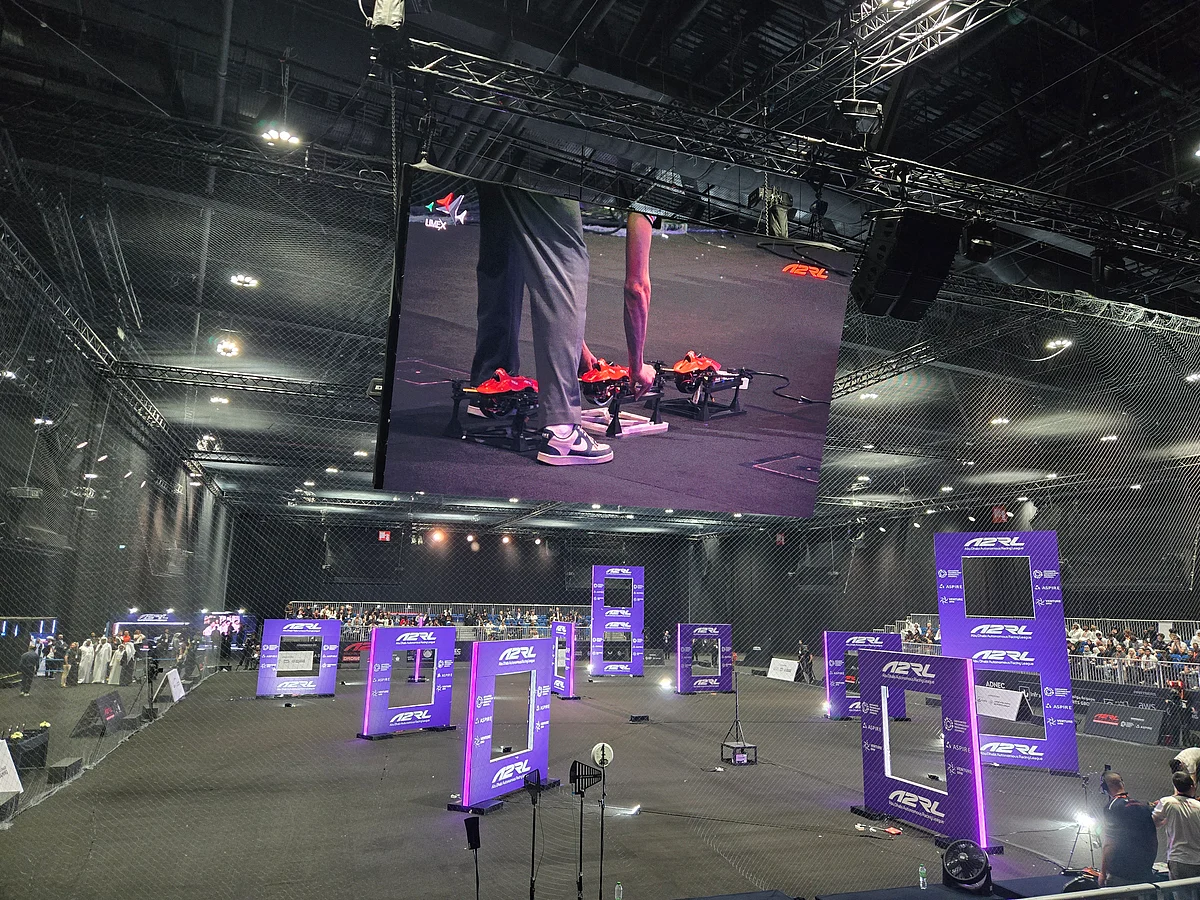
Inside the racing hall at ADNEC Centre Abu Dhabi, a single human pilot sat facing a course he knew by heart, waiting for an autonomous drone to make a mistake. When it finally did, Minchan Kim did not hesitate. The South Korean FPV pilot beat TII Racing’s AI drone in a tense best-of-nine final, closing out the second season of the A2RL Drone Championship with a result few inside the arena had expected—a human finishing ahead of artificial intelligence after a full head-to-head contest.
The final unfolded slowly, almost cautiously at first. Kim did not rush the opening heats, often letting the AI drone take an early lead before flying clean, controlled lines through the gates. The strategy paid off when crashes—rare but costly—began to creep into the AI’s runs. As the heats progressed, the momentum swung back and forth. The AI responded with faster laps, and Kim answered with consistency. At one stage, the scores were level. Then they were level again.
By the time the race reached its final stretch, both sides were locked at four wins apiece, forcing a decisive last heat—a scenario that drew spectators to their feet and left even seasoned FPV pilots watching in silence. In the final run, Kim pushed harder from the start, threading his drone through the opening gates with precision, keeping just enough distance to avoid turbulence from the AI drone ahead. When the AI clipped a gate and failed to recover, the result was sealed.
Stay up to date with the latest news. Follow KT on WhatsApp Channels.
Moments later, Kim removed his goggles, visibly shaken. “Actually, I’m still so nervous,” he said after the race. “Literally when I was flying, I couldn’t even breathe.” Flying alongside an autonomous drone brought its own challenges, he added. “When I fly with AI, I see the AI in front of my camera view, and it makes me so nervous. And sometimes I get really dirty air from the drones, so I had to try to calm myself down.”
Kim said his preparation before each heat was as much mental as technical, carefully positioning his drone on the launch stand to line up with the first gate. “I try to leave my drone as straight as possible to the start gate, so I launch really quick,” he said. “And before I start, I just say to myself, ‘I can do it, I can do it, I can do it.’”
AI speed, human recovery
While Kim took the top spot in the human-versus-AI final, TII Racing’s performance underlined just how close the contest has become. Aaesha Al Shehhi, a senior researcher at the Technology Innovation Institute (TII), said the team’s autonomous drone was among the fastest in the competition—but speed alone was not enough.
“We’re preparing for this for a year now,” she said. “Our team is still very young, about two and a half years, and we’re competing against teams that have been in this field for more than a decade. This year, we managed to be the fastest team in the world.”
What the AI lacks, however, is the ability to recover mid-flight in the way a human pilot can. “The privilege that he has is that he can recover,” Al Shehhi said. “Even if we crash, we cannot recover. He fell, and he was able to recover—that’s the difference.” She explained that AI drones rely heavily on onboard cameras and sensors to navigate the course, making them sensitive to lighting changes and disturbances from other drones flying nearby. “If the drone is not trained for certain lighting, it can affect the camera,” she said. “And when another drone is close, the disturbances can affect the sensors, and the drone loses control.”
Four drones, one command
Earlier in the day, the crowd had already been treated to another rare sight—a four-drone autonomous race, believed to be a first of its kind. All four AI drones launched simultaneously from a single command, their propellers spinning in unison as they squeezed toward the opening gate. The formation lasted only seconds before the limits of autonomous coordination became clear.
Two drones clipped the gates almost immediately. Another spiralled off course. One, however, held its line and completed the track cleanly, drawing applause from the stands. The race offered a glimpse of both the promise and fragility of autonomous flight at speed: tightly choreographed launches, followed by unpredictable interactions once multiple drones shared the same airspace.
A testing ground for autonomy
The A2RL Drone Championship is organised by ASPIRE, the innovation arm of the Advanced Technology Research Council, and is designed to push autonomous systems beyond laboratory conditions and into real-world racing environments. The event forms part of the Unmanned Systems Exhibition and Simulation and Training Exhibition, where defence, aerospace and technology companies gather to showcase advances in autonomous mobility.
For now, the final word belongs to the human. But as Al Shehhi put it, the gap is narrowing—and the lessons learned on the track will shape what comes next. “We train our models with disturbances,” she said. “But sometimes, when you’re racing for real, you only discover the problems after the flight.”
What's Your Reaction?