
















Art should not be limited to ‘celebration of beauty’
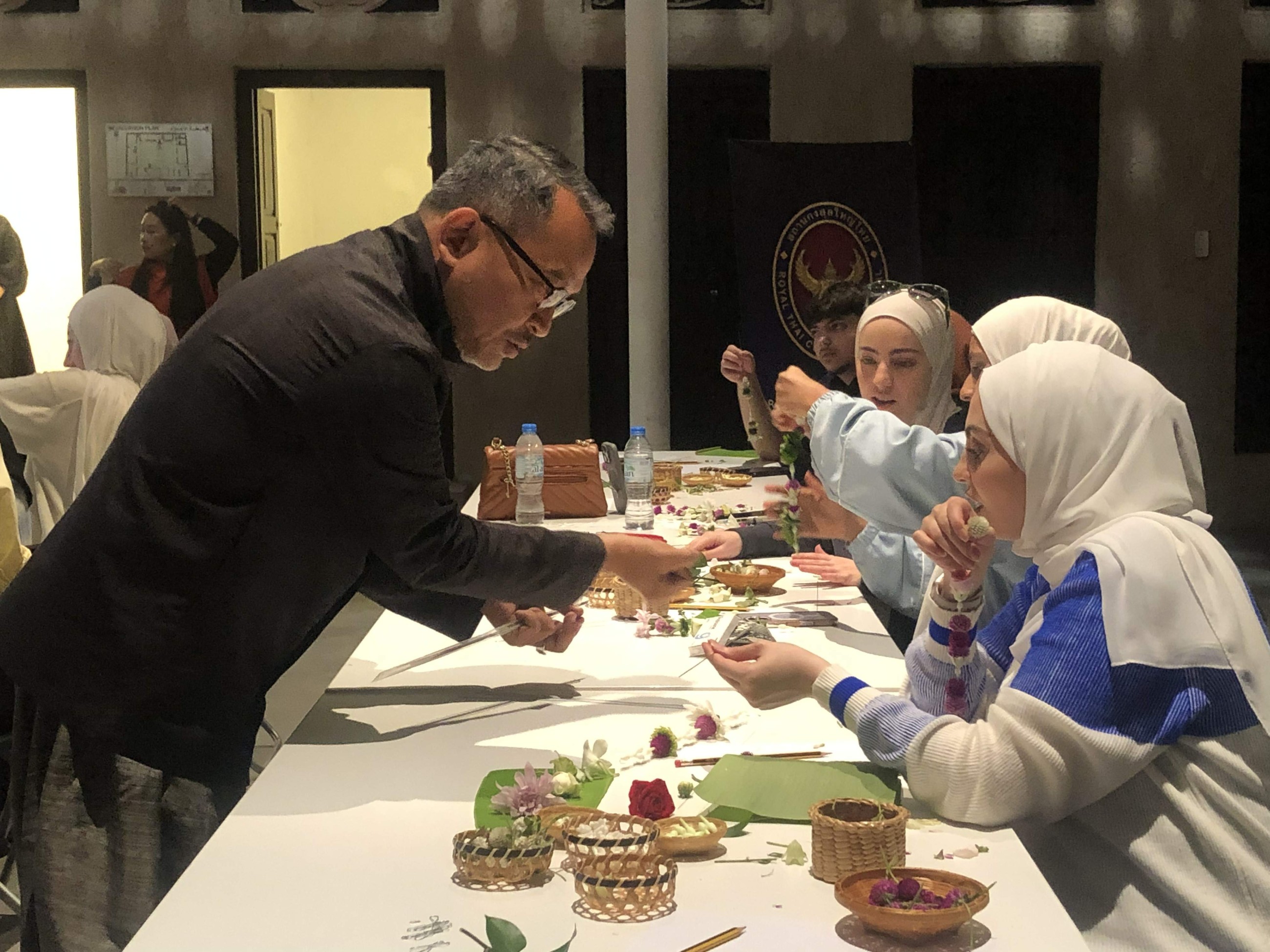
Through all the programmes concerning ecology and the environment, there is one -- from an engineer who has immersed himself in the exquisiteness of flora and foliage since over 30 years back -- the world may consider.The engineer is Master Sakul Intakul who said that while flora and foliage are a language on their own, he also believes that art should not only be limited to the celebration of beauty.Intakul is in the UAE for the second time, since his multi-media art installation for the Golden Anniversary of the Royal Kingdom of Thailand-United Arab Emirates Diplomatic Relations, was revealed during the Dec. 2025 “Thailand National Day Gala Night” in Dubai.Through him as a guest at the “Sikka Arts and Design Festival 2026,” in collaboration with the Royal Thai Consulate General in Dubai, a 1.2 X 4.8 metres of Roi Malai community-driven installation, now serves as the centrepiece within the Community Hall of the Al Shindagha Museum.The Electrical Engineering degree holder from the King Mongkut Institute of Technology Ladkratong, born in a “home surrounded by evergreen orchards” 60 years back, said: “While I do not formally label myself as an environmentalist, my artistic practice carries a deep ecological consciousness. Through my work, I emphasise the intrinsic value of plants and flowers. Not merely as materials, but as living beings with cultural, spiritual, and ecological significance.”“The languages of nature and form are inseparable. I believe that art should not only celebrate beauty; but also encourage awareness, respect, and stewardship of our environmental heritage,” he also said.For two nights and through six workshops, Intakul was able to teach droves of UAE residents and guests, including Peru Consul General in Dubai and the Northern Emirates Katia Mercedes Angeles Vargas and her daughter Olympia, and Germany Consul General Sybille Pfaff, the art of the Roi Malai.For which Thailand Consul General Nipa Ninaroot is happy and thankful to the Dubai Arts and Culture invitation.The Southeast Asian kingdom was able to showcase and demonstrate a tradition which had its beginnings, based on available records, as noted by Intakul in his own “Dok – Mai – Thai (The Flower Culture of Thailand” coffee-table book, 776 years ago, during the Sukhothai Kingdom, located in the present-day north-central Thailand.“Master Sakul is a distinguished artist in Thailand. I met him in Bangkok, through a colleague at the Ministry of Foreign Affairs-Thailand Foundation. I am amazed by the turn-out. We have university students, even children. Other artists, professionals and diplomats,” Ninaroot said.She added: “Shared culture definitely shows that, the arts transcend borders, transcend our differences and unites people together.”For one and specifically Roi Malai, it is the art of creating flower garlands, whether these be the puniest or the most humongous the creator could make; like Intakul who “realised” he “wanted to become a contemporary visual artist” after he was able to form and fashion an “Installation art.”“I was invited to create a floral work for a well-known flower festival in Bangkok. The piece was later described as an ‘installation art,’ although at that time, the term was not even part of my vocabulary,” recalled the Bangkok-born.While Intakul’s urban dwelling was peppered with all kinds of plants the tropical climate could birth, his parents also “encouraged” him to be the young botanist, collecting not only what their garden blooms into, but also the seeds: “That was my earliest creative pursuit.”An electrical engineer later on, the pull of nature and how he could play with it inventively became stronger when he enrolled for a two-year course at a Japanese floral art school: “I discovered how flowers could function as a language, capable of expressing emotion, philosophy, and cultural meaning.” Eventually, Intakul’s scientific know-how, combined with his admiration for the works of British sculptor-photographer-environmentalist Andy Goldsworthy, Japanese-American artist-sculptor-designer Isamu Noguchi, and American artist-sculptor Alexander Calder, let him progress from being a “flower artist to a flower-inspired contemporary visual artist to a flower-inspired installation artist.”Intakul is grateful to the late King Bhumibol Adulyadej and the late Queen Sirikit who not only saw in him his talent; but let him be among the Thais of the Modern World, able to share to the world – Thainess.
Through all the programmes concerning ecology and the environment, there is one -- from an engineer who has immersed himself in the exquisiteness of flora and foliage since over 30 years back -- the world may consider.The engineer is Master Sakul Intakul who said that while flora and foliage are a language on their own, he also believes that art should not only be limited to the celebration of beauty.Intakul is in the UAE for the second time, since his multi-media art installation for the Golden Anniversary of the Royal Kingdom of Thailand-United Arab Emirates Diplomatic Relations, was revealed during the Dec. 2025 “Thailand National Day Gala Night” in Dubai.Through him as a guest at the “Sikka Arts and Design Festival 2026,” in collaboration with the Royal Thai Consulate General in Dubai, a 1.2 X 4.8 metres of Roi Malai community-driven installation, now serves as the centrepiece within the Community Hall of the Al Shindagha Museum.The Electrical Engineering degree holder from the King Mongkut Institute of Technology Ladkratong, born in a “home surrounded by evergreen orchards” 60 years back, said: “While I do not formally label myself as an environmentalist, my artistic practice carries a deep ecological consciousness. Through my work, I emphasise the intrinsic value of plants and flowers. Not merely as materials, but as living beings with cultural, spiritual, and ecological significance.”“The languages of nature and form are inseparable. I believe that art should not only celebrate beauty; but also encourage awareness, respect, and stewardship of our environmental heritage,” he also said.For two nights and through six workshops, Intakul was able to teach droves of UAE residents and guests, including Peru Consul General in Dubai and the Northern Emirates Katia Mercedes Angeles Vargas and her daughter Olympia, and Germany Consul General Sybille Pfaff, the art of the Roi Malai.For which Thailand Consul General Nipa Ninaroot is happy and thankful to the Dubai Arts and Culture invitation.The Southeast Asian kingdom was able to showcase and demonstrate a tradition which had its beginnings, based on available records, as noted by Intakul in his own “Dok – Mai – Thai (The Flower Culture of Thailand” coffee-table book, 776 years ago, during the Sukhothai Kingdom, located in the present-day north-central Thailand.“Master Sakul is a distinguished artist in Thailand. I met him in Bangkok, through a colleague at the Ministry of Foreign Affairs-Thailand Foundation. I am amazed by the turn-out. We have university students, even children. Other artists, professionals and diplomats,” Ninaroot said.She added: “Shared culture definitely shows that, the arts transcend borders, transcend our differences and unites people together.”For one and specifically Roi Malai, it is the art of creating flower garlands, whether these be the puniest or the most humongous the creator could make; like Intakul who “realised” he “wanted to become a contemporary visual artist” after he was able to form and fashion an “Installation art.”“I was invited to create a floral work for a well-known flower festival in Bangkok. The piece was later described as an ‘installation art,’ although at that time, the term was not even part of my vocabulary,” recalled the Bangkok-born.While Intakul’s urban dwelling was peppered with all kinds of plants the tropical climate could birth, his parents also “encouraged” him to be the young botanist, collecting not only what their garden blooms into, but also the seeds: “That was my earliest creative pursuit.”An electrical engineer later on, the pull of nature and how he could play with it inventively became stronger when he enrolled for a two-year course at a Japanese floral art school: “I discovered how flowers could function as a language, capable of expressing emotion, philosophy, and cultural meaning.” Eventually, Intakul’s scientific know-how, combined with his admiration for the works of British sculptor-photographer-environmentalist Andy Goldsworthy, Japanese-American artist-sculptor-designer Isamu Noguchi, and American artist-sculptor Alexander Calder, let him progress from being a “flower artist to a flower-inspired contemporary visual artist to a flower-inspired installation artist.”Intakul is grateful to the late King Bhumibol Adulyadej and the late Queen Sirikit who not only saw in him his talent; but let him be among the Thais of the Modern World, able to share to the world – Thainess.
What's Your Reaction?








Economist Admin
Admin managing news updates, RSS feed curation, and PR content publishing. Focused on timely, accurate, and impactful information delivery.