





















Death Valley landmark reopens to tourists after decade-long closure
Scotty’s Castle, a 1920s vacation home for a millionaire couple and the domain of a famous con man, was a top attraction in Death Valley National Park before it closed from a flash flood. After 10 years of repairs, the landmark is offering limited tours. The castle nestled into a desert hillside tells the perfect Wild West story of a cunning cowboy, a search for gold, a shootout with bandits and friendship. It is a great tale — even if some of it was made up. “The story of how it came to be in this extremely unlikely place is what makes it so special,” said Abby Wines, acting deputy superintendent of Death Valley National Park.The National Park Service opened up the grounds for limited flood-recovery tours in the coming months, and its full reopening is eyed for a few years from now. Around 1.4 million people visit the park located in California and Nevada every year. It is well known as the hottest place in North America and as the driest and lowest place in the continent at 282 feet below sea level. In its heyday, the castle was “the stage for a massive practical joke on all of America,” Wines said.Walter Scott, a con man nicknamed “Death Valley Scotty” and a former rider for the Buffalo Bill Wild West Show, took up gold prospecting, convincing people to invest in a fictional gold mine in Death Valley, where he thought none of his investors would dare to visit. He struck the mother lode when he met Albert Johnson, who made his money in mines and health insurance. He invested in the mine but travelled to Death Valley to see where his money was going.Scott tried to scare the man off by staging a gunfight with bandits. Johnson realized it was a scam, but he didn’t mind. He found the dry desert air good for his health, and he enjoyed the adventure, Wines said. He brought his wife, Bessie Johnson, and they became friends with Scott. Over nine years, they built a vacation home they called Death Valley Ranch. But Scott lived on the grounds until he died, and everyone referred to it as Scotty’s Castle. He is buried on top of a hill overlooking the property.Inspired by the sandstone buildings and red tile roofs of Stanford University, where Bessie Johnson went to school, the castle is decorated with stucco walls, painted tiles and elaborate woodwork. A music room with a player pipe organ, arched ceilings and a stained-glass window served as a space for entertaining guests. Outside, a weather vane of Scott is perched on the roof, and a clock tower overlooks the valley. An incomplete pool shows the point in history when Johnson’s business failed and he couldn’t afford to restart construction.Visitors stopped by the castle to see Scott and his famed gold mine when Death Valley became a national monument in 1933. Continuing his charade, he would tell visitors he built “his” castle on top of the mine. Servants went into tunnels beneath the castle and banged on pots and pans, creating the illusion of a working mine, Wines said.The Johnsons found the story entertaining. When it was open, Scotty’s Castle drew 100,000 visitors every year. Guides dressed in period costumes gave tours of the castle, still with its original furnishings.Interest in the castle remains high; the $35 flood recovery tours scheduled through March are already sold out. The proceeds will go toward completing the restoration, which will cost around $90 million. Repairs, which involved a lot of utility work, have taken longer than expected because of multiple setbacks, including a fire in 2021 and historic rainfall in recent years.“I think what most people connect to when they come out here is the story of the friendship between the rich couple, Albert and Bessie Johnson, and Death Valley Scotty, the man who started the relationship by convincing them to give him money for a gold mine that never existed,” Wines said.Meanwhile it only cost $1.10 to tour Scotty’s Castle in its early days, and the tall tale of Death Valley Scotty attracted the likes of actors Bette Davis and John Barrymore. Scotty continued on with the gold mine con, Wines said, even hiring staff to bang pots and pans in the tunnels built underneath the structure to add to the illusion. Still, there was something entertaining that made the Johnsons trust him. One of Wines’ favorite lines Bessie Johnson wrote in her book “Death Valley Scotty” was her description that “underneath that five gallon hat is a five gallon heart.”Today, Wines and Blacker have high hopes that the castle will one day be full, with people and the original, meticulously preserved artifacts and furniture that are being stored off-site. One of the assurances that a flood won’t delay the opening date is a now-finished berm system that has prepared the site for the worst flooding possible. Sprinklers now hang from the ceiling to fight fires, too. “A couple years from now, it will be again like you’re stepping back in time into the 20s and 30s, the heyday of Scotty’s Castle,” Wines said.Until then, Scotty keeps a watchful
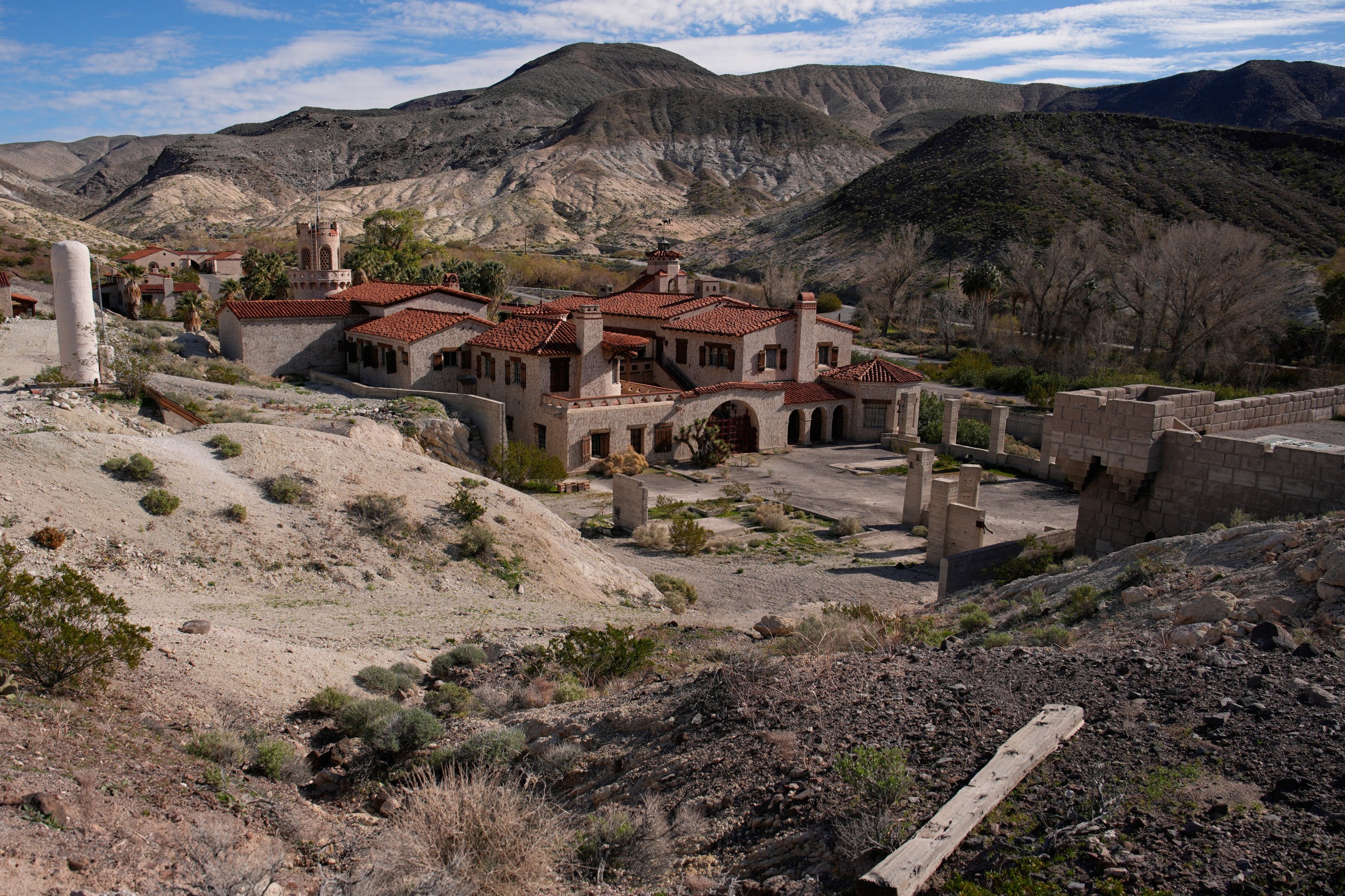
Scotty’s Castle, a 1920s vacation home for a millionaire couple and the domain of a famous con man, was a top attraction in Death Valley National Park before it closed from a flash flood. After 10 years of repairs, the landmark is offering limited tours. The castle nestled into a desert hillside tells the perfect Wild West story of a cunning cowboy, a search for gold, a shootout with bandits and friendship. It is a great tale — even if some of it was made up. “The story of how it came to be in this extremely unlikely place is what makes it so special,” said Abby Wines, acting deputy superintendent of Death Valley National Park.The National Park Service opened up the grounds for limited flood-recovery tours in the coming months, and its full reopening is eyed for a few years from now. Around 1.4 million people visit the park located in California and Nevada every year. It is well known as the hottest place in North America and as the driest and lowest place in the continent at 282 feet below sea level. In its heyday, the castle was “the stage for a massive practical joke on all of America,” Wines said.Walter Scott, a con man nicknamed “Death Valley Scotty” and a former rider for the Buffalo Bill Wild West Show, took up gold prospecting, convincing people to invest in a fictional gold mine in Death Valley, where he thought none of his investors would dare to visit. He struck the mother lode when he met Albert Johnson, who made his money in mines and health insurance. He invested in the mine but travelled to Death Valley to see where his money was going.Scott tried to scare the man off by staging a gunfight with bandits. Johnson realized it was a scam, but he didn’t mind. He found the dry desert air good for his health, and he enjoyed the adventure, Wines said. He brought his wife, Bessie Johnson, and they became friends with Scott. Over nine years, they built a vacation home they called Death Valley Ranch. But Scott lived on the grounds until he died, and everyone referred to it as Scotty’s Castle. He is buried on top of a hill overlooking the property.Inspired by the sandstone buildings and red tile roofs of Stanford University, where Bessie Johnson went to school, the castle is decorated with stucco walls, painted tiles and elaborate woodwork. A music room with a player pipe organ, arched ceilings and a stained-glass window served as a space for entertaining guests. Outside, a weather vane of Scott is perched on the roof, and a clock tower overlooks the valley. An incomplete pool shows the point in history when Johnson’s business failed and he couldn’t afford to restart construction.Visitors stopped by the castle to see Scott and his famed gold mine when Death Valley became a national monument in 1933. Continuing his charade, he would tell visitors he built “his” castle on top of the mine. Servants went into tunnels beneath the castle and banged on pots and pans, creating the illusion of a working mine, Wines said.The Johnsons found the story entertaining. When it was open, Scotty’s Castle drew 100,000 visitors every year. Guides dressed in period costumes gave tours of the castle, still with its original furnishings.Interest in the castle remains high; the $35 flood recovery tours scheduled through March are already sold out. The proceeds will go toward completing the restoration, which will cost around $90 million. Repairs, which involved a lot of utility work, have taken longer than expected because of multiple setbacks, including a fire in 2021 and historic rainfall in recent years.“I think what most people connect to when they come out here is the story of the friendship between the rich couple, Albert and Bessie Johnson, and Death Valley Scotty, the man who started the relationship by convincing them to give him money for a gold mine that never existed,” Wines said.Meanwhile it only cost $1.10 to tour Scotty’s Castle in its early days, and the tall tale of Death Valley Scotty attracted the likes of actors Bette Davis and John Barrymore. Scotty continued on with the gold mine con, Wines said, even hiring staff to bang pots and pans in the tunnels built underneath the structure to add to the illusion. Still, there was something entertaining that made the Johnsons trust him. One of Wines’ favorite lines Bessie Johnson wrote in her book “Death Valley Scotty” was her description that “underneath that five gallon hat is a five gallon heart.”Today, Wines and Blacker have high hopes that the castle will one day be full, with people and the original, meticulously preserved artifacts and furniture that are being stored off-site. One of the assurances that a flood won’t delay the opening date is a now-finished berm system that has prepared the site for the worst flooding possible. Sprinklers now hang from the ceiling to fight fires, too. “A couple years from now, it will be again like you’re stepping back in time into the 20s and 30s, the heyday of Scotty’s Castle,” Wines said.Until then, Scotty keeps a watchful eye over his castle — even though, as Wines points out, it wasn’t really his. Scotty died in 1954 and is buried up on a hill with a wooden cross, ready to greet the next round of visitors. His grave offers some final advice: “I got four things to live by: Don’t say nothing that will hurt anybody. Don’t give advice — nobody will take it anyway. Don’t complain. Don’t explain.”Agencies
What's Your Reaction?








Economist Admin
Admin managing news updates, RSS feed curation, and PR content publishing. Focused on timely, accurate, and impactful information delivery.